


The Pecos League is an independent professional baseball league operating in the San Francisco Bay Area and communities throughout the desert and mountain regions of Arizona, California, Colorado, Kansas, New Mexico, Oklahoma, and Texas. The league primarily serves cities without Major League or Minor League Baseball franchises and is not affiliated with either organization. Pecos League teams generate revenue through ticket sales, sponsorships, concessions, merchandise, and streaming broadcasts.
During its inaugural season in 2011, the Pecos League was centered along the Pecos River corridor, stretching from Alpine, Texas, to Roswell, New Mexico.
The Roswell Invaders played the first ever game in Cohen Stadium defeating the El Paso Diablos 10-7
 The Roswell Invaders and
Alpine Cowboys were two of the league's six original franchises.
In 2012, after numerous failed attempts to land in Pueblo, Colorado and Del Rio, Texas, the league expanded into Santa Fe, New Mexico, with the
 Santa Fe Fuego, and Trinidad, Colorado, with the
Trinidad Triggers.
These four franchises have remained foundational members of the Pecos League throughout its history.
 The league continued expanding in 2015 with the establishment of the
Garden City Wind in Garden City, Kansas.
In 2016, the Pecos League entered the Tucson, Arizona, market with the founding of the
Tucson Saguaros. Tucson set the all time attendance record with 11,825 fans on 4th of July 2016.
 A major milestone followed in 2017 when the league expanded into California by relocating the
Bakersfield Train Robbers from Topeka, Kansas, to Bakersfield.
This expansion established the league's two-division structure, with the Pacific Division and Mountain Division champions meeting in a championship series following their respective divisional playoffs.
That structure remains the foundation of the Pecos League's postseason format.
 In 2019, the Pecos League acquired the San Rafael Pacifics, bringing the franchise into the league for the 2020 season.
The league also expanded into Martinez, California, in 2020 with the establishment of the
Martinez Sturgeon.
Additional expansion followed in 2023 with the founding of the
Dublin Leprechauns in Dublin, California, and the
Blackwell Flycatchers in Blackwell, Oklahoma.
In 2024, the league returned to its geographic roots in West Texas, with the establishment of the
Pecos Bills.
 The league expanded into western Colorado in 2026 with the founding of the
Grand Junction Razorback Suckers.
In 2027, the Pecos League will reestablish its four-team presence in the San Francisco Bay Area with the addition of the
Burlingame Jellyfish.
This geographic alignment will allow the four Bay Area teams to compete in home-and-away series with travel distances of less than 30 miles, eliminating the need for overnight accommodations.
 The Houston Apollos
played FEPCUBE at the University of Miami in Coral Gables, Florida,
on January 31, 2024.
FEPCUBE had planned to make its international debut at the 2024
Intercontinental Series in Colombia under the slogan "Patria y Vida."
However, the tournament was canceled following political and diplomatic
pressure from the Cuban and Colombian governments.
The efforts of FEPCUBE did not go to waste. The team played two games,
one against Miami Dade College and another against the Houston Apollos.
Livan Hernandez threw out the ceremonial first pitch, and nearly every
notable Cuban baseball player who had played in Major League Baseball
over the previous 30 years was in attendance.
The Apollos did not walk a single batter but ultimately lost
2-0
.
FEPCUBE scored its two runs on a home run by
Leonys Martin
and an RBI single by
Victor Mesa Jr.
 On April 5 and 6, 2025, the Pecos League hosted
Charros de Jalisco
and
Bravos de Leon
at Sam Lynn Ballpark in Bakersfield, California.
The game on April 5 set the stadium's all-time attendance record.
Billy Hamilton returned to Bakersfield, where he had previously
starred for the Bakersfield Blaze, the Cincinnati Reds'
California League affiliate.
On October 9 and 10, 2026, the Pecos League hosted the Houston Apollos and the Aguilas de Mexicali for two exhibition games in preparation for the upcoming winter baseball season.
The Pecos League has developed a reputation for organizing and operating traveling teams for other independent professional baseball leagues, often stepping in when unexpected circumstances create scheduling challenges.
 In 2017, the Pecos League assembled the
Salina Stockade
as a full-season traveling team in the American Association.
The Stockade replaced the Laredo Lemurs, who had folded just one week earlier following an FBI investigation.
 In 2018, the Pecos League again organized the
Salina Stockade,
this time for an 18-game schedule in the Can-Am League.
The team was added to balance the league's schedule and accommodate games involving the Cuban National Team.
Later in 2018, the Pecos League assembled the
Hollywood Stars
for a nine-game schedule in the Can-Am League.
This emergency arrangement became necessary when a team from the Dominican Republic was unable to obtain authorization to cross the Canadian border.
In 2019, the Pecos League organized the
Salina Stockade
as a full-season traveling team in the Pacific Association.
League officials were concerned that the Napa Silverados might be unable to fulfill their schedule.
However, Napa ultimately participated throughout the entire season, resulting in a five-team league.
 In 2021, the Pecos League established the
Houston Apollos
as a full-season traveling team in the American Association.
The Apollos filled a scheduling need while the Lake Country DockHounds prepared to begin play in the 2022 season.
The Pecos League maintains a distinctive style of professional baseball by continuing to play without a designated hitter, preserving the traditional National League rules used before 2020, in which pitchers bat for themselves. The league also maintains unique uniform standards, with teams wearing solid-colored tackle twill jerseys rather than traditional white or gray uniforms. Players are required to use Major League Baseball-approved bats.
 Rawlings is the official baseball supplier of the Pecos League, and only Rawlings game balls are permitted in league competition.
The Pecos League uses a custom-made Rawlings baseball specifically designed for durability and longevity.
These baseballs have been available for public purchase since 2012 and have become especially popular among college baseball programs.
The Pecos League currently operates with two divisions. The Pacific Division consists of the league's California-based teams, while the Mountain Division includes teams located outside California. Since joining the league in 2016, the Tucson Saguaros have competed in both divisions at different times. The Saguaros play their home games at Kino Stadium in Tucson, which is widely regarded by the league as one of the premier facilities available to independent professional baseball in the United States.
By the 2027 season, California will be home to five Pecos League franchises, making it the state with the largest concentration of teams in the league. The league's California presence reflects its continued growth in the San Francisco Bay Area and the Central Valley.
Beginning with the 2026 season, PrestoSports became the official scoring platform for all Pecos League teams. From 2011 through 2025, the league used Pointstreak, a scoring and statistical platform that had been widely used throughout independent professional baseball since 2010.
The Pecos League is known for its high-scoring games, powerful offenses, elevated ballparks, and unique playing environments. Many Mountain Division ballparks are located at significant elevations, with an average elevation of approximately 4,870 feet. The combination of thinner air, smaller ballparks, and competitive offensive talent creates an exciting brand of baseball for fans.
Pecos League players come from across the United States and around the world. They represent a diverse collection of rising stars, established veterans, players working to revive their careers, and aspiring professionals pursuing their dreams of advancing in baseball. The league provides these athletes with an opportunity to compete professionally while bringing affordable summer entertainment to communities that take tremendous pride in their hometown teams.
Pecos League teams operate with 22-player rosters, generally consisting of 11 experienced players and 11 rookies. The league does not use the designated hitter, requiring pitchers to participate in the batting order. The regular season takes place during the heart of summer, generally running from late May through late July. This schedule allows communities, families, and baseball fans to enjoy professional baseball during the peak summer months, encouraging strong local participation and support.
Players Who Reached MLB


Team / Cities

History of the Pecos League
- In 2026 (Map) The Pecos League operated 15 teams with the Garden City Wind defeating the Martinez Sturgeon in the Pecos League Championship Series.
- In 2025 (Map) The Pecos League operated 16 teams with the Tucson Saguaros defeating the San Rafael Pacifics in the Pecos League Championship Series.
- In 2024 (Map) The Pecos League operated 16 teams with the Alpine Cowboys defeating the San Rafael Pacifics in the Pecos League Championship Series. The Pecos League operated the Houston Apollos who played the FEPCUBE Cuban Freedom Game at University of Miami.
- In 2023 (Map) The Pecos League operated 16 teams with the San Rafael Pacifics defeating the Tucson Saguaros in the Pecos League Championship Series.
- In 2022 (Map) The Pecos League operated 16 teams with the Roswell Invaders defeating the Tucson Saguaros in the Pecos League Championship Series.
- In 2021 (Map) The Pecos League operated 14 teams with the Tucson Saguaros defeating the Roswell Invaders in the Pecos League Championship Series.
- In 2020 The Pecos League operated 4 teams with the Tucson Saguaros winning both the regular season and post season title.
- In 2019 The Pecos League operated 12 teams with the Alpine Cowboys winning the Mountain Division and the Pecos League Championship.
- In 2018 The Pecos League operated 12 teams with the Bakersfield Train Robbers winning the Pacific Division and the Pecos League Championship.
- In 2017 The Pecos League operated 12 teams with the High Desert Yardbirds winning the Pacific Division and the Pecos League Championship.
- In 2016 The Pecos League operated 10 teams with the Tucson Saguaros winning both the regular season and post season title.
- In 2015 The Pecos League operated 8 teams with the Roswell Invaders winning the post season title and the Trinidad Triggers winning the regular season title.
- In 2014 The Pecos League operated 10 teams with the Santa Fe Fuego winning the post season title and the Alpine Cowboys winning the regular season title.
- In 2013 The Pecos League operated 8 teams with the Roswell Invaders winning both the regular season and post season title.
- In 2012 The Pecos League operated 6 teams with the Alpine Cowboys winning both the regular season and post season title.
- In 2011 The Pecos League operated 6 teams with the Roswell Invaders winning both the regular season and post season title.
In the offseason of 2023 the Pecos League lost Lancaster as the stadium was sold to USL Soccer team. With this move the Pecos League had to balance the Pacific Division with six teams. The Monterey Amberjacks contract was not renewed in time by the city due to insurance requirements that could not be met. This made the decision easy for the Pecos League. The Pecos League and the City of Monterey vowed to return in the 2025 season.
The results of these moves lead the Pecos League to North Platte Nebraska and Pecos Texas for the 2024 season. North Platte is one of the fastest growing cities in the United States and Pecos Texas recently built a state of the Sports Complex and was an original Pecos League City in 2012.
Previous Seasons
Pecos League Champions
Garden City Wind — 2026 Pecos League Champions
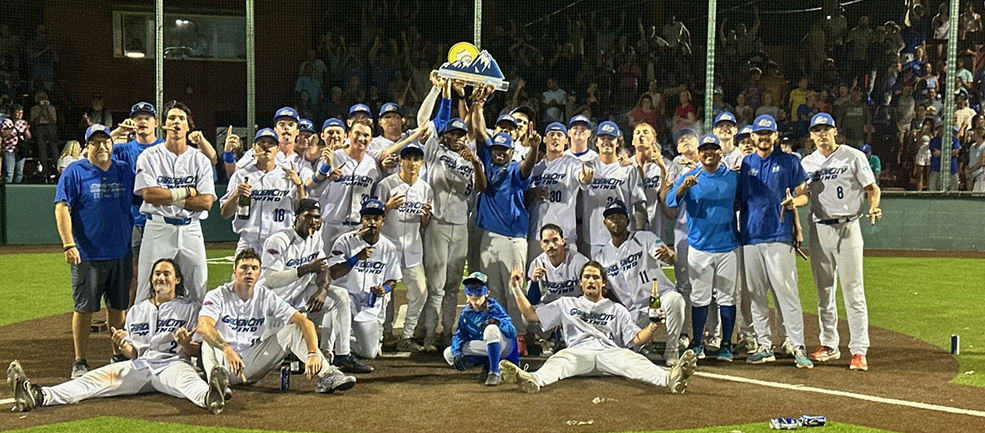
Tucson Saguaros — 2025 Pecos League Champions

Alpine Cowboys — 2024 Pecos League Champions

San Rafael Pacifics — 2023 Pecos League Champions

Roswell Invaders — 2022 Pecos League Champions

Tucson Saguaros — 2021 Pecos League Champions

Tucson Saguaros — 2020 Pecos League Champions

Alpine Cowboys — 2019 Pecos League Champions

Bakersfield Train Robbers — 2018 Pecos League Champions

High Desert Yardbirds — 2017 Pecos League Champions

Tucson Saguaros — 2016 Pecos League Champions

Roswell Invaders — 2015 Pecos League Champions

Santa Fe Fuego — 2014 Pecos League Champions

Roswell Invaders — 2013 Pecos League Champions

Alpine Cowboys — 2012 Pecos League Champions

Roswell Invaders — 2011 Pecos League Champions

The Formation of the Pecos League
The End of the Continental Baseball League and the Beginning of the Pecos League
The Pecos League was founded in 2010 following the collapse of the Continental Baseball League, an independent professional baseball league that operated throughout the southwestern United States.
Near the conclusion of the 2010 season, Ryan Stevens, Donnie Randal, JR Smith, Andrew Dunn and Bob Ward met in Van Horn, Texas, to discuss the possibility of establishing a new independent baseball league.

The goal was straightforward but challenging: create a league that would allow the Las Cruces Vaqueros and the Big Bend Cowboys to continue playing professional baseball.
At the time, only two viable organizations remained from the Continental League. Andrew Dunn owned the Las Cruces Vaqueros, while Bob Ward and a group of supporters in Alpine, Texas, wanted to preserve professional baseball in the Big Bend region.
The original Big Bend Cowboys franchise had been owned by Frank Snyder, a law professor based in Fort Worth, Texas.
Ron Baron had already informed the remaining teams that 2010 would be the Continental Baseball League's final season. With the league preparing to cease operations, the remaining organizations faced a difficult choice: establish a new league or abandon professional baseball in their communities.
The group in Van Horn chose to move forward. The new league was organized in August 2010 and named the Pecos League, after the Pecos River that runs through the region from northern New Mexico toward West Texas.
Andrew Dunn became commissioner of the Pecos League and agreed to take responsibility for owning half of the proposed league's teams. He had already reached an agreement to establish a franchise in Roswell, New Mexico.
The founders believed that six teams would give the new league a realistic opportunity to succeed. A six-team schedule would provide enough opponents, regional rivalries and games to establish a legitimate independent baseball operation.
What initially appeared to be a manageable goal would prove far more difficult than anyone anticipated.
The First Four Teams Join the Pecos League
The first official team to commit to the Pecos League was located in Alamogordo, New Mexico.
The franchise was originally expected to be called the Alamogordo Kingfish. However, Matt McNeile renamed the team the White Sands Pupfish, creating one of the most distinctive identities in independent baseball.
McNeile strongly believed that Alamogordo needed professional baseball and confidently predicted that the Pupfish would become the most successful team in the new league.
His prediction proved remarkably accurate during the league's inaugural season.
The Las Cruces Vaqueros became the second franchise to join, followed by the Roswell Invaders as the third team.
All three organizations — White Sands, Las Cruces and Roswell — were owned by Andrew Dunn.
The fourth franchise was the Alpine Cowboys.
Rather than continuing under the ownership structure of the former Big Bend Cowboys, a group of Alpine supporters established a new organization operated by a nonprofit board. The team would preserve the Cowboys baseball tradition and provide the Big Bend region with a place in the new league.
With four teams committed, the Pecos League appeared to be making progress toward its six-team goal. However, finding the final two franchises would become the greatest challenge of the league's formation.
Bisbee Arizona: The Perfect Baseball Town That Wouldn't Join
One of the most obvious candidates for expansion was Bisbee, Arizona.
Bisbee was home to historic Warren Ballpark, one of the most recognizable baseball facilities in the Southwest. The community had a strong baseball tradition, an established fan base and a team known as the Bisbee Copper Kings.
What Bisbee lacked was a consistent group of opponents. Joining the Pecos League appeared to be an ideal solution.
Andrew Dunn met in Las Cruces with Copper Kings owner Tom Mosher about becoming the league's fifth franchise. Mosher brought his manager, Bill Moore, to the meeting.
Mosher had previously operated a successful baseball organization in Bisbee, and the opportunity to join a regional league offered an obvious advantage: a regular schedule against established opponents.
Unfortunately, the negotiations quickly reached an impasse.
Mosher was unwilling to commit to playing road games, paying a league entry fee or covering hotel accommodations for visiting teams.
Those requirements were essential to operating a professional league. Without a commitment to travel and share the financial responsibilities of league membership, Bisbee could not participate.
Bill Moore attempted to persuade Mosher to join, but the two sides could not reach an agreement.
The Bisbee Copper Kings ultimately folded and did not play another season.
Although Bisbee did not become a founding member, Bill Moore would go on to have a major impact on the Pecos League. He helped establish the Santa Fe franchise in 2012 and eventually became the winningest manager in Pecos League history.
Bisbee would later host a Pecos League team for one season in 2014, and Warren Ballpark would host selected Sunday games for the Tucson Saguaros in 2016 and 2017.
The failure to secure Bisbee was an early lesson for the new league: having a great ballpark and a strong baseball tradition did not necessarily mean a community could support the financial demands of independent professional baseball.
Clovis New Mexico: Another Opportunity Falls Apart
The next serious opportunity came in Clovis, New Mexico.
Clovis had Bell Park, an established baseball facility, and appeared to be a strong geographic fit for the league.
In September 2010, discussions with Bill Bizzell and representatives of the City of Clovis produced an initial agreement to bring Pecos League baseball to the community.
Former Major League Baseball player John Harris agreed to serve as the team's field manager.
The pieces appeared to be coming together. However, an unexpected problem emerged regarding the ballpark itself.
Although the Pecos League had been negotiating with city officials, Bell Park was no longer controlled by the City of Clovis. The facility was owned by the Clovis School District.
When the agreement was scheduled to be finalized in January 2011, the league learned that the school district wanted $50,000 for use of the ballpark and would not permit beer sales.
Those conditions made the proposed franchise financially impractical.
Complicating matters further, John Harris accepted a managerial position in Amarillo with the United League.
With the ballpark agreement unresolved and the proposed manager departing, the Clovis franchise never materialized.
For the second time, a seemingly promising expansion opportunity had fallen apart.
Ruidoso New Mexico: A Community Willing to Give Baseball a Chance
With the inaugural season approaching and only four confirmed franchises, Andrew Dunn decided to establish a team in Ruidoso, New Mexico.
Dunn was willing to organize the franchise himself and lease its operation to another owner under a one-year agreement. The immediate priority was to get the Pecos League onto the field for its first season.
Unlike some of the other communities the league had approached, the Village of Ruidoso was extremely supportive of the idea.
There were significant obstacles.
White Mountain Park did not have lights, meaning games would have to be played during daylight hours. Beer sales were also unavailable, eliminating a potential revenue source for the team.
Nevertheless, local officials and baseball supporters were enthusiastic about bringing professional baseball to the mountain community.
Many Ruidoso baseball fans were already familiar with the Pecos League's emerging teams, having attended games in Roswell and Alamogordo.
There were also efforts to add lighting to White Mountain Park, which would have made the facility more practical for professional baseball.
Despite its limitations, Ruidoso provided something the league desperately needed: a community willing to participate.
The Ruidoso Osos would become the fifth team in the inaugural Pecos League.
Del Rio Texas: A Team That Could Have Changed the League
Another community the Pecos League strongly wanted to include was Del Rio, Texas.
Del Rio offered the possibility of expanding the league's geographic footprint and creating additional regional baseball opportunities.
League officials pursued the possibility of establishing a full-time franchise in the community.
However, the mayor blocked the proposal to bring a permanent Pecos League team to Del Rio.
The league was ultimately permitted to stage four exhibition games in Del Rio during its inaugural season, but the community would not become a full-time member.
Once again, the Pecos League was forced to look elsewhere for its sixth team.
The Carlsbad Bats: The Final Piece of the Puzzle
With five teams in place and the 2011 season rapidly approaching, the Pecos League still needed one final franchise.
The solution would be a travel team known as the Carlsbad Bats.
Carlsbad, New Mexico, was geographically located near the center of the league's original territory and had a proud baseball tradition.
Despite having a population of approximately 30,000, Carlsbad had produced several Major League Baseball players and was widely regarded by local baseball supporters as one of New Mexico's great baseball communities.
A Carlsbad identity made sense for the league, even though the Bats would operate primarily as a road team rather than a conventional home-based franchise.
The City of Carlsbad would not permit the team to use its municipal baseball fields for a regular home schedule. Despite the city's ideal geographic location between Alpine and the New Mexico franchises, the Bats would be forced to operate entirely as a travel team.
Carlsbad did eventually permit a three-game series at Caveman Corral on Father's Day weekend during the inaugural season.
Andrew Dunn arranged to lease the travel team to the New York State League, operated by Jay Acton.
Acton had extensive experience organizing and operating travel teams throughout independent baseball dating back to 1990.
His involvement provided the Pecos League with an experienced operator capable of fielding a competitive team while handling the unusual demands of a road-based schedule.
The Carlsbad Bats became the sixth and final franchise needed to launch the league.
Six Teams and One Opportunity
After months of negotiations, setbacks and changes in direction, the Pecos League finally had its six founding teams.
- White Sands Pupfish — Alamogordo, New Mexico
- Las Cruces Vaqueros — Las Cruces, New Mexico
- Roswell Invaders — Roswell, New Mexico
- Alpine Cowboys — Alpine, Texas
- Ruidoso Osos — Ruidoso, New Mexico
- Carlsbad Bats — Carlsbad, New Mexico (Travel Team)
The inaugural schedule called for six teams playing four days per week during May before expanding to seven days per week in June and July.
The process of assembling those six franchises had revealed just how difficult it was to establish an independent professional baseball league in the Pecos region.
The founders had encountered ownership disagreements, unsuccessful ballpark negotiations, prohibitive facility costs, restrictions on alcohol sales, communities without adequate stadium lighting and local governments unwilling to approve professional baseball.
Bisbee had a historic stadium but would not accept the financial obligations of league membership.
Clovis had a ballpark and an experienced manager but lost its opportunity because of facility costs and restrictions.
Del Rio offered potential but would not permit a permanent franchise.
Ruidoso was willing to participate despite lacking lights and traditional stadium revenue opportunities.
Carlsbad provided the identity for a travel team that would make the six-team schedule possible.
Each of these decisions helped shape the Pecos League's original operating model.
Major Improvements Over the Continental Baseball League
The Pecos League introduced several important operational changes that distinguished it from the Continental Baseball League.
One of the most significant improvements was joining Pointstreak as a professional statistics partner. This allowed the Pecos League to maintain official statistics, standings, player records and game information through a centralized professional baseball statistics platform.
The league also moved its operational center from Dallas, Texas, to Las Cruces, New Mexico, placing its administration much closer to the teams and communities it served.
Another important decision was to eliminate the designated hitter rule. Pecos League pitchers would be required to bat, creating a more traditional style of baseball and adding another strategic element to every game.
These changes reflected the league's intention to establish a more organized, geographically focused and sustainable model for independent professional baseball.
The Beginning of a New Era in Independent Baseball
The Pecos League was not created through a major financial investment, an established ownership group or a collection of fully developed professional baseball franchises.
It was created because a small group of baseball people refused to allow independent professional baseball to disappear from the region after the Continental Baseball League folded.
The original vision was to preserve baseball in Las Cruces and Alpine while creating opportunities for new franchises in communities that larger professional leagues had overlooked.
Andrew Dunn's willingness to own and organize multiple teams, the commitment of the Alpine nonprofit ownership group, the support of community leaders in Alamogordo and Ruidoso, and the involvement of experienced baseball operators all contributed to making the league possible.
The challenges were considerable, and there was no guarantee that the new league would survive even one season.
But by the time preparations for 2011 were complete, the Pecos League had accomplished its first major objective.
It had six teams, a plan for an inaugural season and an opportunity to keep independent professional baseball alive in the Southwest.
What began with a meeting in Van Horn, Texas, in 2010 would become the foundation of the Pecos League.
The league was ready to play ball in 2011.


